What Happens to AVD Usage During the Holidays? Real Data Tells the Story

We’ve just come through the New Year period, and our session data tells a fascinating story. Let’s look at what actually happened — and what it means for your AVD scaling strategy.
The Real Data: Dec 31 – Jan 6
Here’s actual user session data from one of our monitored environments over the past week:
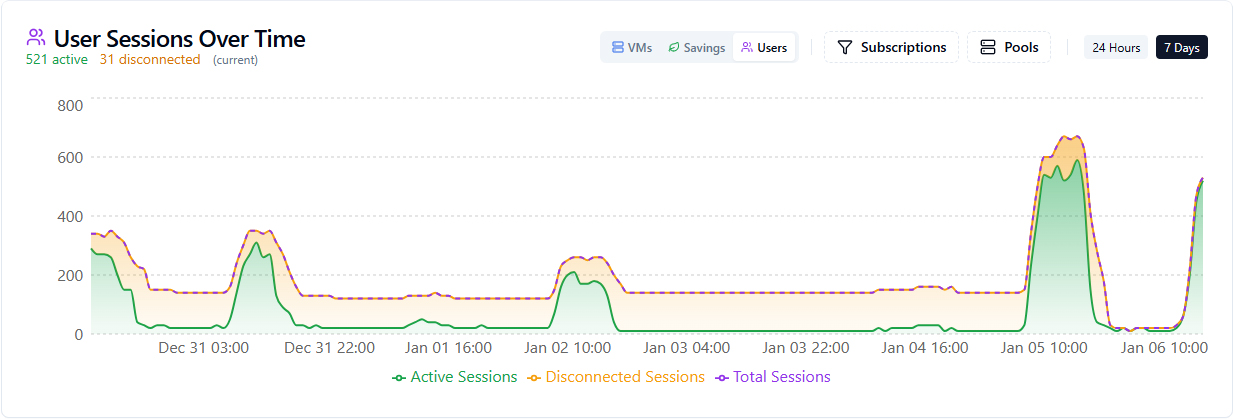
The chart shows three key metrics: Active Sessions (green fill), Disconnected Sessions (orange dashed), and Total Sessions (purple dashed). Let’s break down what we’re seeing:
| Period | Active Sessions | Pattern |
|---|---|---|
| Dec 31 (morning) | ~350 | Normal start, then rapid drop |
| Dec 31 – Jan 1 | 20-50 | Ghost town — New Year’s Eve/Day |
| Jan 2 | ~250 | Gradual return |
| Jan 3-4 (weekend) | 100-150 | Weekend skeleton crew |
| Jan 5 (Monday) | 600+ | Everyone back — peak surge |
| Jan 6 | 500+ | Sustained high demand |
The swing from 20 sessions to 600+ sessions is a 30x difference. If your scaling isn’t prepared for this, you’re either wasting money or frustrating users.
Three Key Insights
1. Holidays Are Not Just “Quiet”
New Year’s Day saw almost no activity. But look at what happened on Jan 5 — the first Monday back. Usage didn’t just return to normal; it exceeded typical levels.
Why? Catch-up work. Emails piled up. Deadlines postponed. Everyone logging in at once.
If your scaling assumes “normal Monday = X hosts”, you’ll be caught short. The return-to-work surge needs capacity headroom.
2. Weekends During Holidays Are Different
The Jan 3-4 weekend showed about 100-150 active sessions. That’s higher than a typical holiday day but lower than a normal weekend.
Why? Some teams had skeleton crews. Some people checked in before Monday’s rush.
This matters because you can’t apply the same weekend rules during holiday periods. Context matters.
3. The Ramp-Up Isn’t Gradual
Look at Jan 5: sessions jumped from overnight lows to 600+ within hours. This isn’t a gentle curve — it’s a cliff.
Implication: Your scaling needs to be responsive. Pre-warming hosts before 9am makes a huge difference to user experience when everyone hits login simultaneously.
What This Means for Your Scaling
Without Intelligent Scaling
- Dec 31 – Jan 1: Paying for 50 VMs when you need 5
- Jan 5 morning: 5 VMs trying to handle 600 users (login storms, poor performance)
With Holiday-Aware Scaling
- Dec 31 – Jan 1: Scale down aggressively — save 90%+
- Jan 5 morning: Pre-scale based on historical patterns, ready for the surge
The difference isn’t marginal. It’s the difference between smooth logins and support tickets flooding in.
Lessons for Capacity Planning
1. Historical Data Is Gold
This isn’t guesswork. We’re looking at actual session patterns from actual environments. Every organisation has its own rhythm — bank holidays, industry-specific peaks, company events.
Track it. Analyse it. Use it.
2. Disconnected Sessions Matter
Notice how the chart shows both active and disconnected sessions. Those disconnected users still consume resources. They might reconnect any moment.
Factor this into your capacity calculations. “Active sessions” alone doesn’t tell the whole story.
3. Plan for the Surge, Not the Average
If your average is 300 sessions but your peak is 600, you need capacity for 600. The Smart Scaler doesn’t just react — it anticipates.
How We Handle This
The Smart Scaler incorporates several features for exactly these scenarios:
- Holiday calendar awareness: Knows when to expect reduced demand
- Return-to-work surge handling: Pre-warms hosts before predictable peaks
- Historical pattern learning: Understands your organisation’s rhythms
- Real-time responsiveness: Scales within minutes when demand spikes unexpectedly
The Bottom Line
The holiday period demonstrates why simple time-based scaling falls short. Demand isn’t predictable by clock alone — it’s shaped by calendars, events, and human behaviour.
Real data shows:
- 30x variation between holiday lows and return-to-work peaks
- Hours, not days for demand to spike back up
- Context matters — weekends during holidays behave differently
Your scaling solution should understand this. Ours does.
Want to see how your own AVD environment behaves during holidays and peak periods? The Smart Scaler provides exactly this kind of visibility — plus the intelligent scaling to act on it.